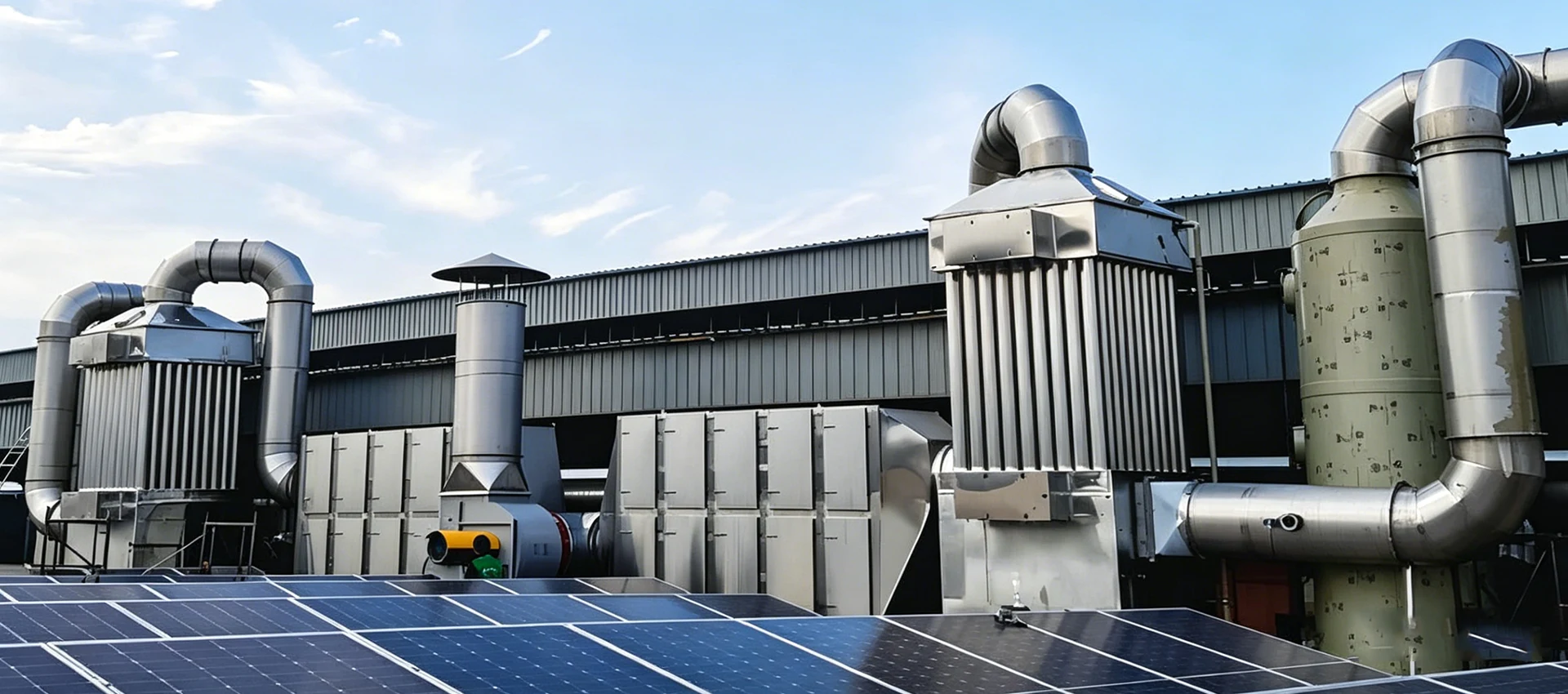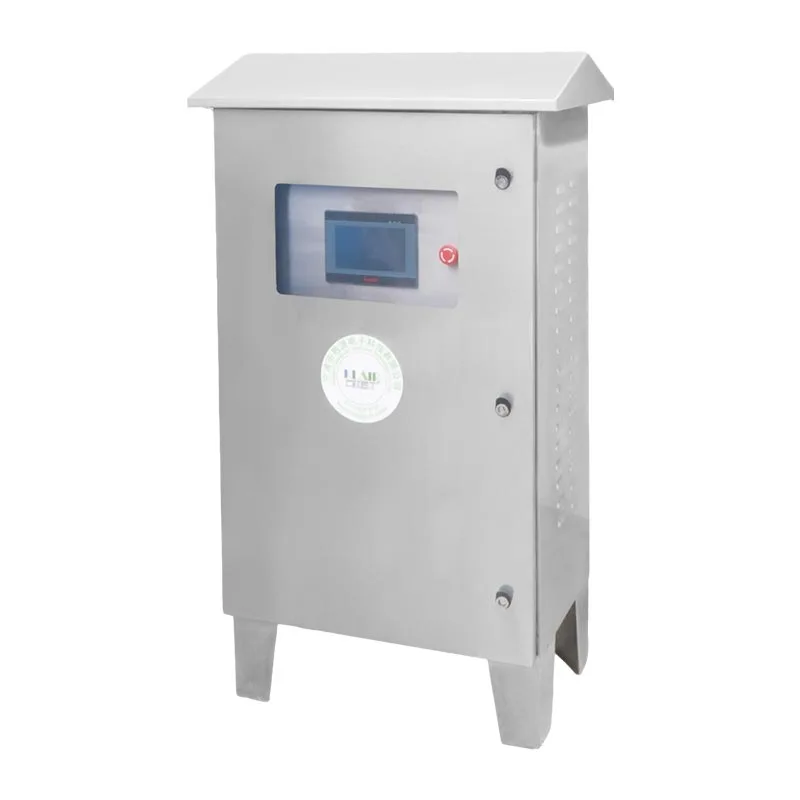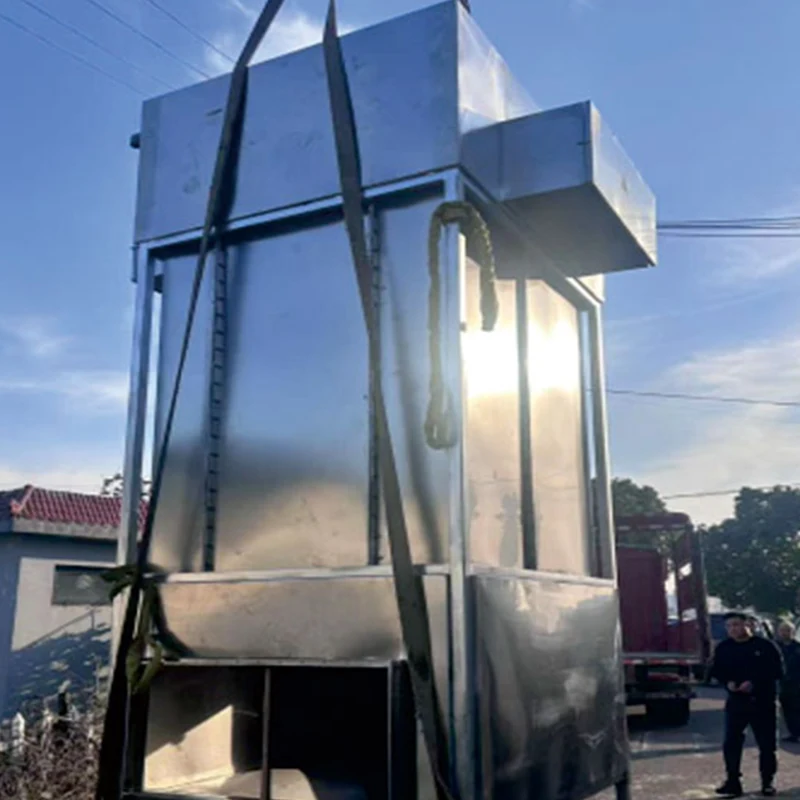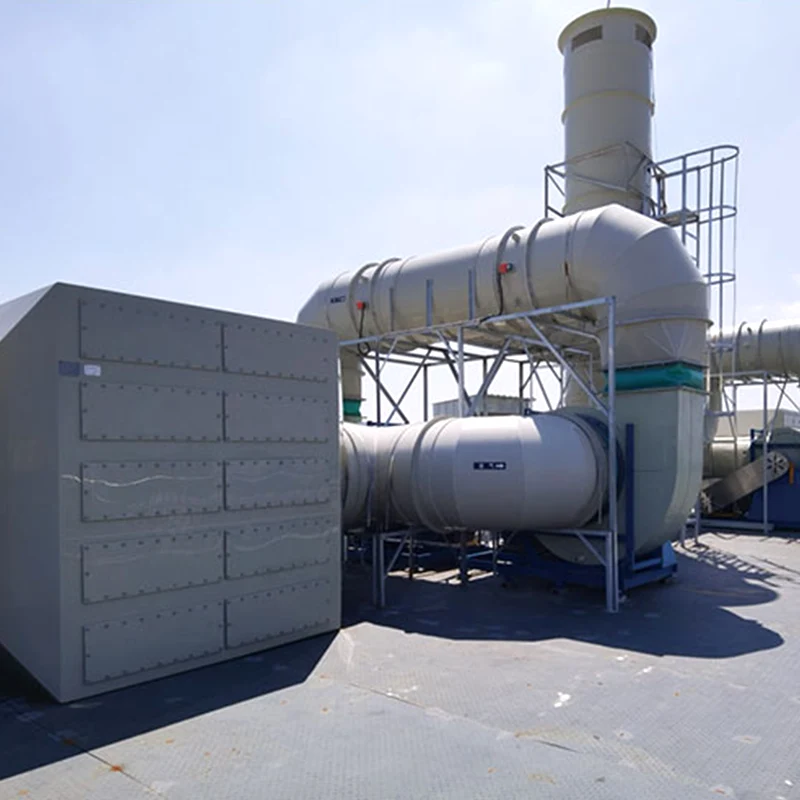
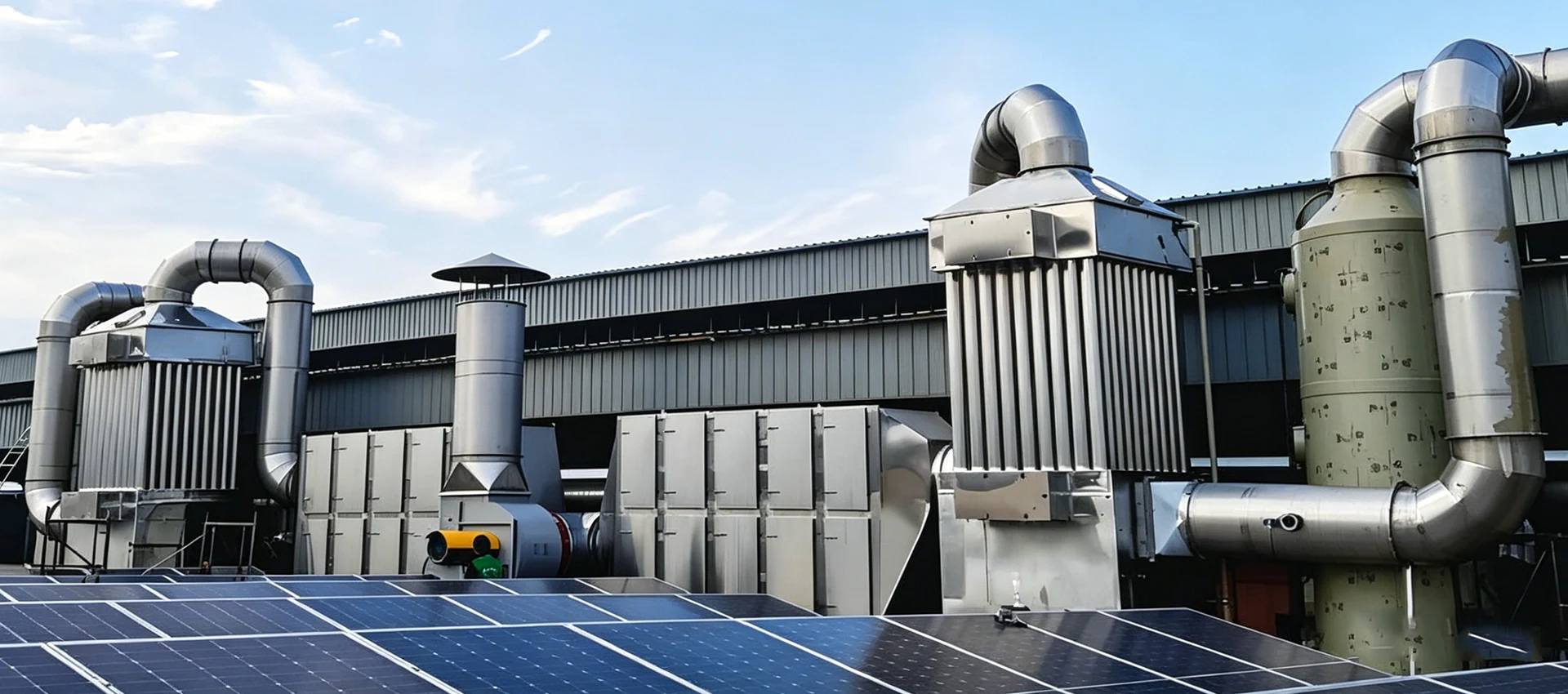
Industrial VOC treatment strips volatile organic compounds out of factory exhaust before it reaches the air. Six methods do most of the work: thermal oxidation (RTO), catalytic oxidation, adsorption, wet scrubbing, low-temperature plasma, and biological deodorization. Which one fits comes down to your VOC concentration, airflow, and temperature. Our RTO hits a 99%+ VOCs removal rate at 95%+ heat recovery.
What VOCs Are and Where They Come From
VOCs are carbon-based chemicals that turn to vapor at normal working temperatures. Solvents, coatings, inks, adhesives, resins — they all give them off. So does any process that heats plastics, oils, or organic material.
Untreated, VOCs feed ground-level ozone, trigger odor complaints, and put workers and neighbors at risk. But the reason most plants call us is simpler: the local emission limit, and an audit they cannot afford to fail.
Here is where the load usually comes from, and what tends to ride along with it.
| Source process | Typical VOCs | Usually mixed with |
|---|---|---|
| Spray painting & coating | Solvents, esters, aromatics | Paint mist, overspray |
| Printing & packaging | Ink and adhesive solvents | Alcohol vapor |
| Plastics & pyrolysis | Mixed organics from heating | Smoke, particulate |
| Chemical & pharma | Reaction solvents, VOCs | Acid mist, odor |
| Metal heat-treating | Oil-derived hydrocarbons | Oil mist, PM, NOx |
That last column matters more than people expect. What travels with the VOCs often decides the treatment train — not the VOCs themselves. We build across all of these under our waste gas treatment equipment line.
The Six VOC Treatment Methods
Every method here does one of three jobs: it destroys the VOCs, it captures them, or it converts them biologically. Sort a technology into the right bucket and the trade-offs get obvious.
Thermal Oxidation (RTO)
Burn the compounds off. Heat the exhaust hot enough and the organics break down into carbon dioxide and water.
The regenerative thermal oxidizer, or RTO, does this while reusing most of its own heat through ceramic beds. That is why ours runs at a 99%+ VOCs removal rate with 95%+ heat recovery. Best on medium-to-high, fairly steady concentrations. Wasteful on very dilute air.
For streams carrying carbon monoxide, we build a two-stage CO oxidation furnace at 99%+ conversion, common in metallurgy and building materials.
Catalytic Oxidation
Same idea, lower temperature. A catalyst lets the reaction fire at a fraction of the heat, so fuel use drops. The catch: silicones, halogens, and heavy metals poison the catalyst, so the incoming gas has to stay clean and predictable.
Adsorption: Activated Carbon and Zeolite Rotor
Adsorption traps VOCs on a porous surface instead of destroying them. Activated carbon is cheap and simple for low, on-off loads, but it saturates and needs swapping.
For big, dilute airflows, a zeolite rotor concentrator earns its keep. It pulls VOCs out of a huge stream and hands off a small, concentrated one that a compact oxidizer finishes. Coating and electronics plants lean on this pairing.
Wet Scrubbing and Wet ESP
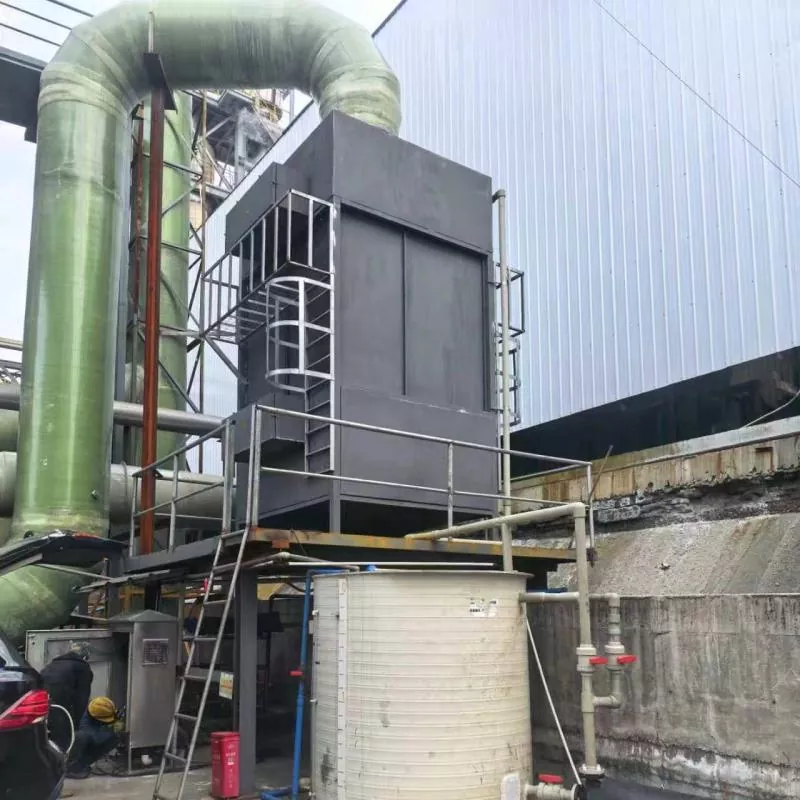
When acid mist, soluble gases, or fine particulate ride along, water gets involved. A scrubber absorbs the soluble stuff; a wet electrostatic precipitator (wet ESP) charges and collects sub-micron droplets that filters miss. We often run these ahead of an oxidizer so the destruction stage sees a cleaner gas. Both are built for chemical and metallurgical acid-mist duty.
Low-Temperature Plasma
Plasma cracks VOC and odor molecules with a high-voltage field, near room temperature. Compact, fast to respond, good for low and swinging loads.
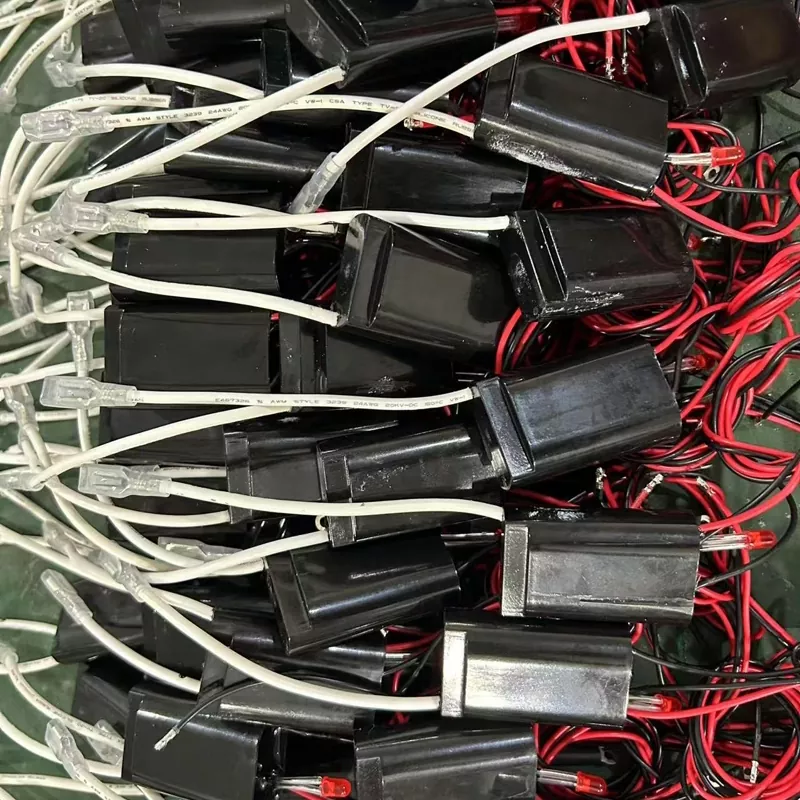
The weak point in most plasma units is the power supply. We design around our own self-developed high-voltage power supply so the field stays stable instead of drifting.
Biological Deodorization
Microbes eat the odor and organic load, leaving CO2, water, and biomass. Running cost is low. It suits steady, biodegradable streams — food waste, livestock, wastewater, biopharma. Our corrosion-resistant PP biological deodorization tower covers acidic, alkaline, and odor loads with little upkeep.
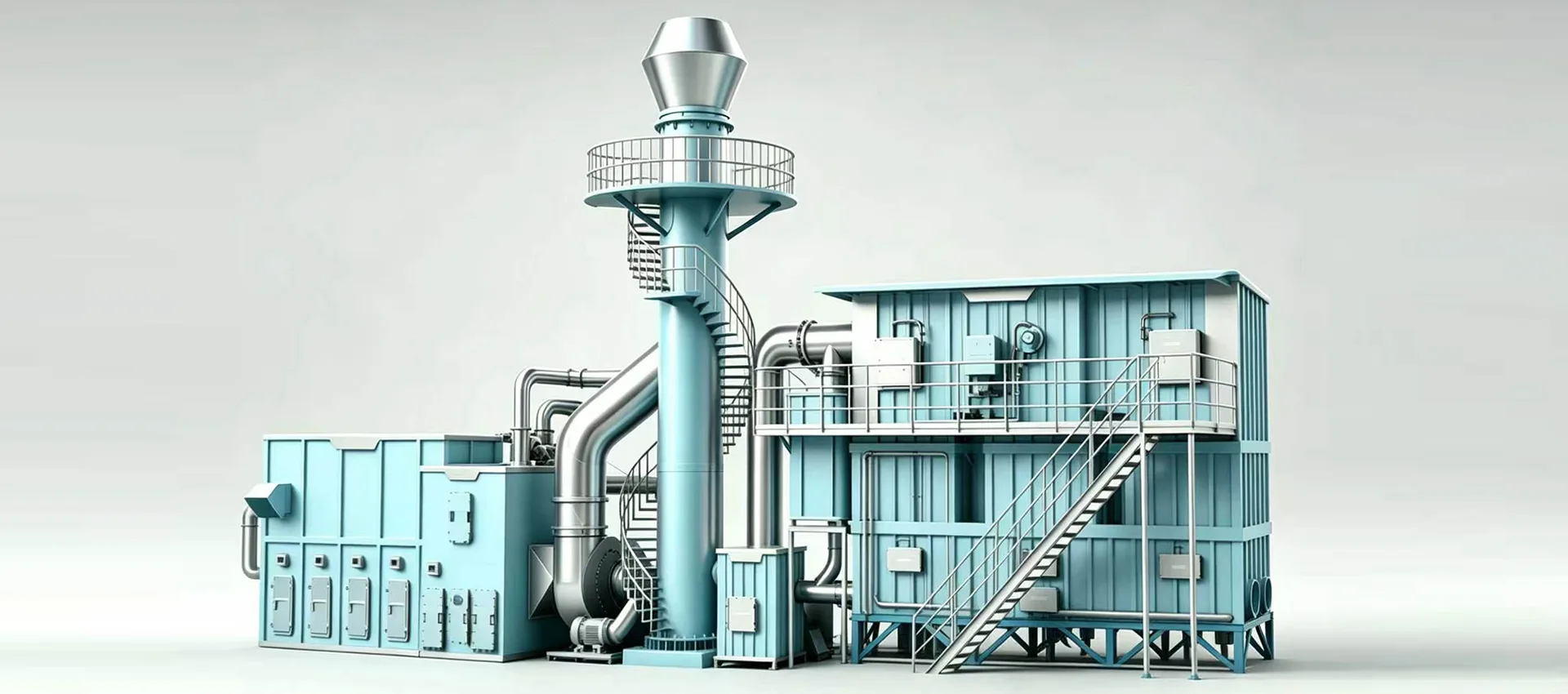
VOC Treatment Methods Compared
Use this as a shortlist, not a verdict. Real exhaust almost always needs a combination.
| Method | Fits VOC level | Fits airflow | Strong point | Weak point |
|---|---|---|---|---|
| Thermal oxidation (RTO) | Medium–high | Medium–large, steady | Top destruction, strong heat recovery | Poor economics when dilute |
| Catalytic oxidation | Low–medium | Small–medium | Lower temperature and fuel | Catalyst poisons easily |
| Adsorption (carbon/rotor) | Low, dilute | Large | Concentrates dilute air | Media saturates; needs a burner |
| Wet scrubbing / wet ESP | Acid mist, particulate | Wide range | Grabs mist and fine PM | Pretreatment, not VOC destruction |
| Low-temp plasma | Low, variable | Small–medium | Compact, near-ambient | Only as good as its power supply |
| Biological | Low, biodegradable | Steady | Cheapest to run | Slow to handle load swings |
How to Pick the Right Method
We ask for three numbers before we recommend anything: concentration, airflow, temperature. Add the pollutants riding along and the shortlist writes itself. Match your situation to the table below.
| Your situation | Where to start |
|---|---|
| High concentration, steady load | RTO or catalytic oxidation |
| Huge airflow, very dilute VOCs | Zeolite rotor + compact oxidizer |
| Low, on-off VOCs | Activated carbon or plasma |
| Acid mist or heavy particulate present | Wet scrubber / wet ESP as pretreatment |
| Odor-driven, biodegradable stream | Biological deodorization tower |
| Carbon monoxide in the stream | Two-stage CO oxidation furnace |
Most factories tick more than one row. That is why the systems we ship are layered: pretreatment, then core destruction, then a polishing stage. The industry cases lower down show how those layers stack in real plants.
What a VOC Treatment System Costs
Buyers often want a price before we know the gas. Fair, but airflow alone can move the number several times over. Here is what actually drives it.
| Cost driver | Effect | Why |
|---|---|---|
| Airflow volume | Biggest single factor | Bigger gas volume, bigger equipment, more energy to treat |
| VOC concentration | High | Sets whether oxidation self-sustains or needs added fuel |
| Composition | Medium–high | Corrosive or poisoning compounds force pricier materials |
| Removal target | High | Chasing the last few percent adds stages |
| Energy use | Ongoing | Where heat recovery pays back; our RTO runs 95%+ |
Watch total cost of ownership, not the sticker. A cheap unit that guzzles fuel or saturates its media fast will cost more over five years than a well-matched one. Correct sizing is the biggest lever you hold. Oversize the system and you pay for it twice — once to buy it, again every month to run it.
Emission Compliance: EPA, EU and GB
Every market polices VOCs its own way. The limit that binds you depends on your industry, your site, and what is in the stream, so compliance starts with knowing which rulebook applies.
| Market | Framework | Set by |
|---|---|---|
| United States | Clean Air Act, EPA rules | US EPA (plus state limits) |
| Europe | Industrial Emissions Directive | EU + national regulators |
| China | GB emission standards | National / provincial |
On delivery, every system passes a three-stage quality check, and we issue a Performance Guarantee Certificate for removal rates up to 99%+. On-site commissioning and third-party testing assistance are part of the package for EPA, EU, or GB sign-off. Overseas, that continues after start-up: 24/7 remote support, video-guided installation, and free spare parts for critical components inside the warranty.
VOC Treatment by Industry
The winning combination shifts by sector. We have written up the process trains we build most often — each starts from the methods above and lands somewhere different.
| Industry | Typical process train | Full write-up |
|---|---|---|
| Three-acid exhaust | Spray tower + wet ESP | Read |
| Hot forging / thermal machines | Multi-stage purification | Read |
| Photovoltaic (EVA pyrolysis) | Zeolite wheel + RTO | Read |
| Quenching exhaust | Pretreatment + core + deep stage | Read |
For solar plants specifically, we also build dedicated photovoltaic VOC treatment equipment matched to the full production line.
Not sure which method fits your factory?
Send your VOC concentration, flow rate, temperature, and local limit. Our engineers reply with a matched, costed solution within 12 hours. No obligation.
Get a Free AssessmentFrequently Asked Questions
Which VOC treatment method should I use?
It depends on three numbers: your VOC concentration, your airflow, and your gas temperature. High, steady concentrations point to thermal or catalytic oxidation. Low, dilute streams point to adsorption or plasma. Streams with acid mist or particulate need a wet stage first. Send us those numbers and your local emission limit, and we will match a process.
How much VOC does an RTO remove?
Our RTO reaches a 99%+ VOCs removal rate with 95%+ heat recovery efficiency. The heat recovery is what keeps fuel cost down on medium-to-high concentration streams.
What makes one VOC system cost more than another?
Airflow is the biggest factor, followed by VOC concentration and composition, the method chosen, the removal rate you need, materials of construction, and daily energy use. Oversizing is the most common way buyers overpay, which is why we size to real gas data.
How do you prove the system meets emission standards?
Every system passes a three-stage quality check before delivery, and we issue a Performance Guarantee Certificate for removal rates up to 99%+. We also provide on-site commissioning and third-party testing assistance for EPA, EU, or local GB standards.
What after-sales support do overseas buyers get?
24/7 remote technical support, video guidance for installation, and free spare parts for critical components within the warranty period. When a project needs it, we send engineers overseas for on-site supervision.
Written by the DeFa Engineering Team at DeFa Environmental Equipment (Ningbo) Co., Ltd., a manufacturer of waste gas treatment, air purification, and industrial dust removal systems with over 20 years of experience. Performance figures (99%+ VOCs removal, 95%+ heat recovery, 99%+ CO conversion) reflect DeFa equipment specifications. Emission limits vary by industry and country; confirm the standard that governs your site before finalizing a design.