Technical explainer for industrial exhaust projects. Sources checked October 8, 2026.
A wet scrubber can remove some VOCs when the selected liquid can absorb them under the actual operating conditions. A water spray tower is a poor default choice for a mixture dominated by poorly water-soluble solvent vapor. Adding more nozzles cannot, by itself, overcome unfavorable gas–liquid equilibrium.
Before increasing tower size or pump capacity, answer three questions: Which compounds remain in the outlet? How much pollutant is already in the circulating liquid? Does the tower provide the contact its design requires? These checks separate a chemistry mismatch from a maintenance or operating problem.
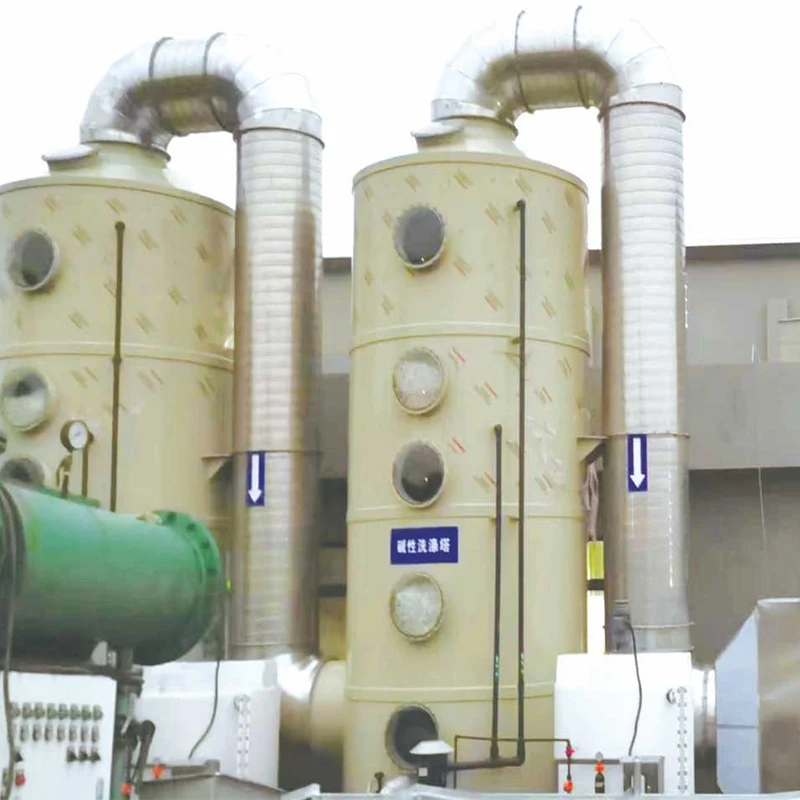
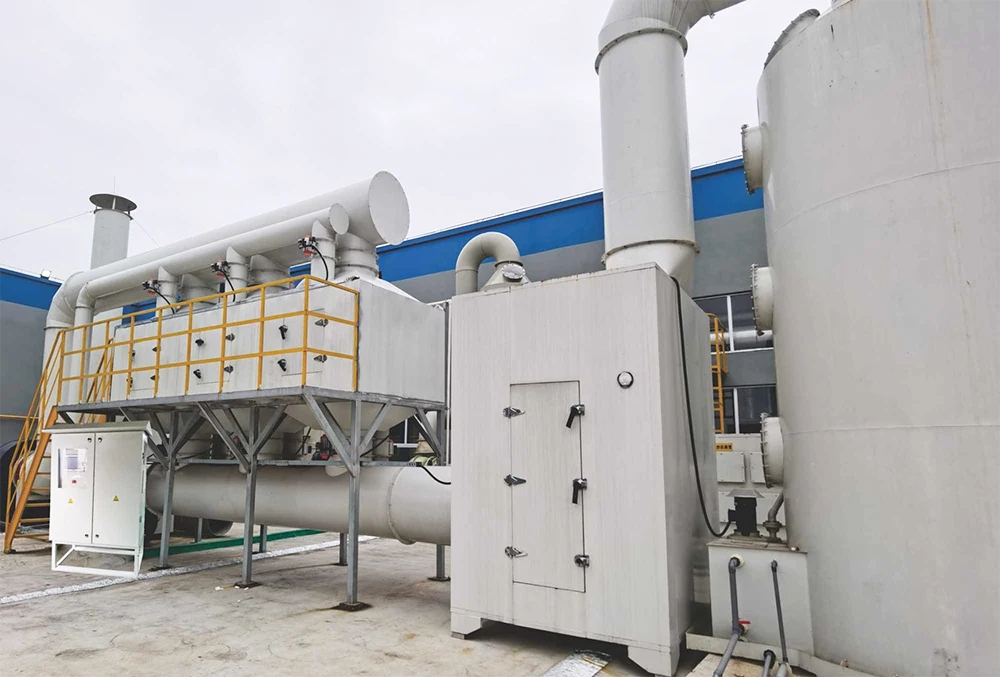
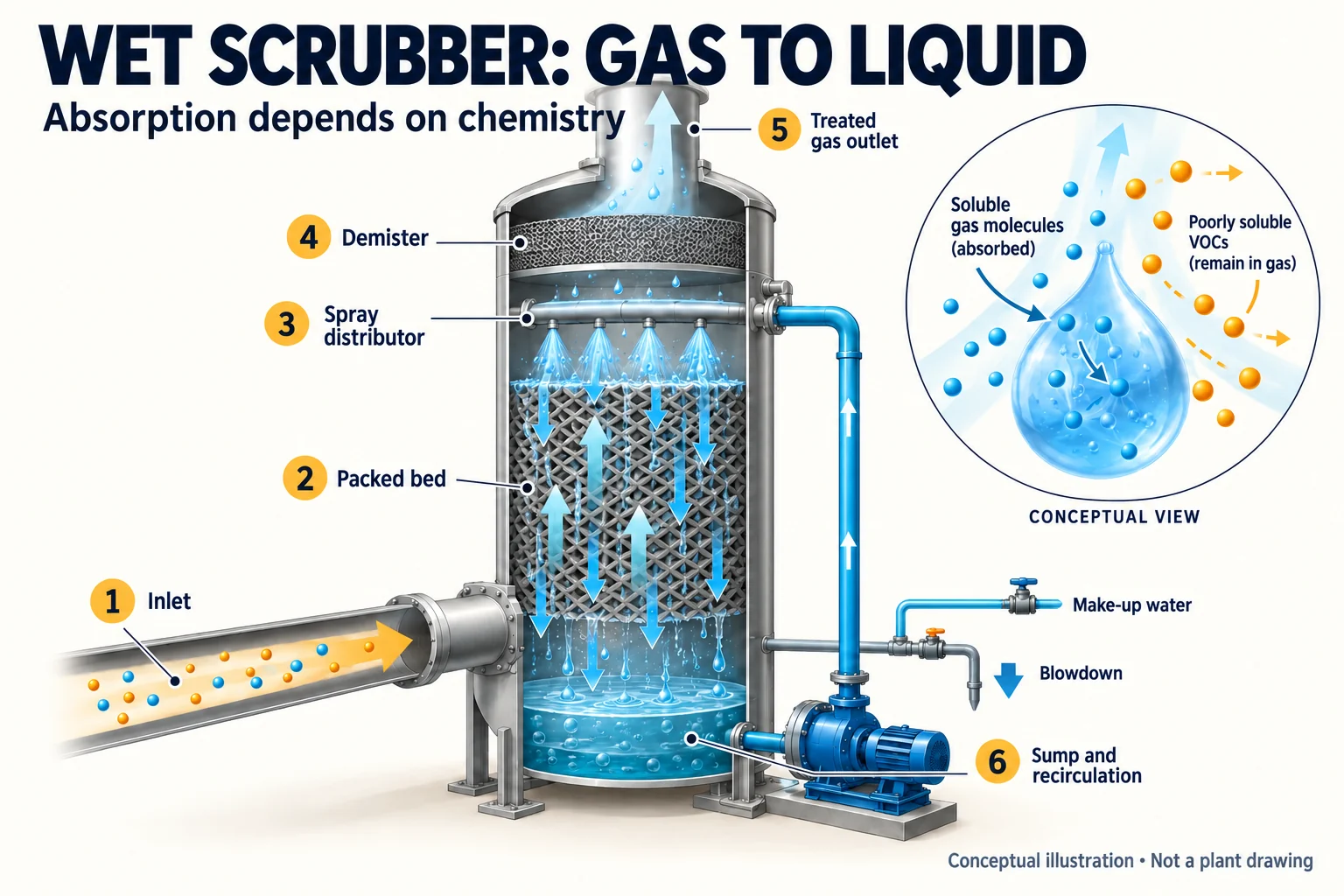 Packed scrubber working principle: absorption occurs during gas–liquid contact, while the demister separates entrained droplets. Conceptual illustration; molecules and flow arrows are schematic.
Screen the pollutant before choosing a wet scrubber
“Waste gas” can contain solvent molecules, acid gases, liquid aerosols and solid particles at the same time. A successful acid-gas test does not establish solvent removal, and a visibly cleaner plume does not establish vapor removal. Start by separating those duties in the process description and laboratory report.
The EPA packed-tower scrubber fact sheet identifies absorption as a possible VOC control method, especially for water-soluble compounds, while noting that packed scrubbers are used more commonly for inorganic gases. It also discusses solvent recovery from the absorbing liquid. That qualification matters when a proposal describes one tower as a general-purpose VOC solution.
| Stream constituent | What to investigate | Evidence to request |
|---|---|---|
| Water-soluble solvent vapor, such as methanol | Water absorption may be worth evaluating; useful capacity still depends on temperature, liquid loading and equilibrium. | Compound-specific outlet prediction at the highest expected circulating-liquid concentration. |
| Poorly water-soluble solvent vapor, such as toluene | Plain water may leave substantial vapor in the outlet. | Gas–liquid equilibrium calculation, solvent-specific treatability evidence, or an alternative recovery or destruction route. |
| Acid or alkaline gas mixed with solvents | Reactive absorption can address the inorganic component while a separate stage handles remaining organics. | Separate inlet and outlet results for the acid/base constituent and each important solvent. |
| Oil droplets, acid mist or overspray | Droplet capture is a different duty from vapor absorption. | Aerosol characterization, separator selection and vapor sampling that distinguishes phases. |
| Unidentified “total VOC” | No defensible absorbent choice yet. | Speciation across production and cleaning cycles before a performance guarantee. |
The chemical contrast is real: NIOSH lists methanol as water-soluble, while its toluene entry lists water solubility of 0.07% at 74°F. These properties support screening; they do not supply a tower removal percentage. High liquid solubility alone does not establish the outlet achievable in a flowing absorber.
For a wider technology shortlist, use the industrial VOC treatment guide. This page focuses on deciding what a scrubber can realistically contribute.
Why pH and pump size do not tell the whole story
pH is useful only when it tracks the relevant chemistry
A pH reading can help track a neutralization duty. It cannot establish the concentration of every dissolved organic compound. A loop may retain its pH while dissolved solvent accumulates and absorption becomes less favorable. Ask which operating variable actually tracks the compound the system must remove.
Adding alkali to a scrubber selected for acid-gas removal does not automatically make it effective for neutral solvent vapor. Any proposed chemical reagent needs a compound-specific reaction basis, consumption estimate and liquid-treatment plan. A trade name or a generic “VOC reagent” description is insufficient.
Recirculation improves contact; blowdown removes accumulated load
A pump sends liquid over the packing again. That movement can support wetting, but it does not continuously replace the liquid with clean absorbent. A larger recirculation rate and a larger blowdown rate solve different problems.
A useful diagnostic question is whether gas removal deteriorates as the liquid becomes more loaded, despite stable gas flow, temperature and liquid distribution. If so, investigate liquid quality and regeneration or disposal capacity before assuming that the tower needs more packing.
In its gaseous-control monitoring guidance, EPA describes absorption as dependent on the gas and liquid pollutant concentrations. It identifies pressure differential, liquid flow and liquid outlet concentration as primary indicators and discusses poor distribution, loaded liquid and re-entrainment as operating problems.
A worked example: where does the captured solvent go?
Teaching example—assumed inputs, not plant measurements or expected equipment performance. Assume a single, nonreacting soluble VOC; steady operation; compatible flow and concentration bases; and no meaningful storage change, degradation or other liquid loss.
- Inlet gas flow: 10,000 m³/h
- Inlet VOC concentration: 500 mg/m³
- Assumed captured fraction: 20%
- Assumed operating concentration of dissolved VOC in blowdown: 2 kg/m³, not a discharge standard
Inlet load = 10,000 × 500 ÷ 1,000,000 = 5 kg/h.
Assumed transfer to liquid = 5 × 0.20 = 1 kg/h. The remaining gas carries 4 kg/h.
Blowdown required by this simplified pollutant balance = 1 ÷ 2 = 0.5 m³/h. This calculation assumes makeup water contains none of the target VOC and blowdown is the only liquid pollutant-removal route. It does not establish the full water balance or prove that 2 kg/m³ allows the target gas outlet.
Increasing the assumed capture to 80% would transfer 4 kg/h to liquid. At the same assumed liquid concentration, that requires 2 m³/h of blowdown in this simplified balance. Better air capture therefore changes the liquid duty; it does not eliminate the pollutant.
The example gives a purchasing team two useful checks. First, ask where the captured kilograms go. Second, compare the proposed blowdown or regeneration capacity with that mass. A recirculation-pump rating alone cannot answer either question.
Use the VOC mass loading calculation guide for unit and sampling-basis details. Actual solvent mixtures, reactions, liquid losses and transient storage require a fuller balance.
Troubleshoot poor VOC removal in a useful order
Record a paired gas-and-liquid snapshot during the problem: production recipe, inlet and outlet speciation, gas flow, temperature, liquid flow, liquid composition, blowdown and pressure drop. Comparing separate days without that context can confuse a process change with an equipment failure.
| Observation | Check next | What the result may indicate |
|---|---|---|
| Acid removal is satisfactory; solvent vapor remains high. | Which compounds dominate the gas outlet? Are they compatible with the liquid? | The acid stage may be doing its job while a separate solvent-control duty remains. |
| Removal improves after liquid replacement, then falls. | Trend dissolved solvent, temperature and inlet load across the cycle. | Accumulation or changing equilibrium may limit the loop. A single fresh-water test may overstate sustained performance. |
| Outlet rises with a new solvent recipe. | Compare individual compounds, not only the total VOC reading. | The original liquid or treatment train may not cover the new recipe. |
| Pressure drop rises and droplets appear downstream. | Inspect packing and the demister for deposits, flooding or drainage faults. | Hydraulic restriction or liquid carryover may be involved. |
| Pump status looks normal, but performance changes abruptly. | Verify measured liquid delivery and distribution; inspect nozzles and bypass paths. | An energized pump does not prove that the packing is wetted as designed. |
| Gas concentration falls without a convincing liquid balance. | Check flow basis, dilution, condensate, sample conditioning and transient storage. | The apparent removal needs verification before crediting a treatment mechanism. |
These patterns guide investigation; they do not identify a cause on their own. The most useful evidence is a repeatable change tied to controlled operating conditions.
Specify what leaves the scrubber before choosing the next device
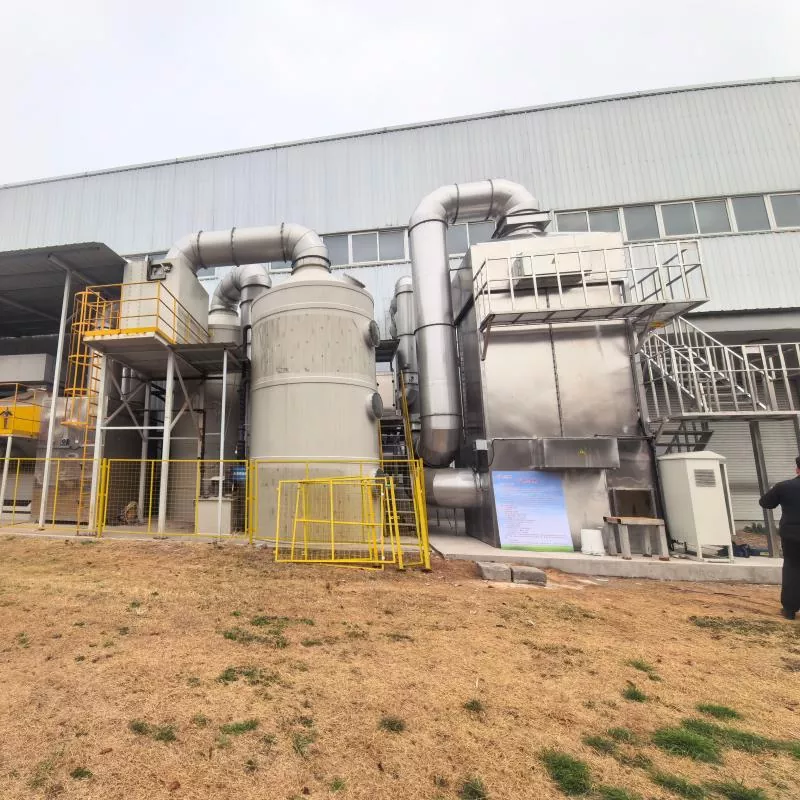
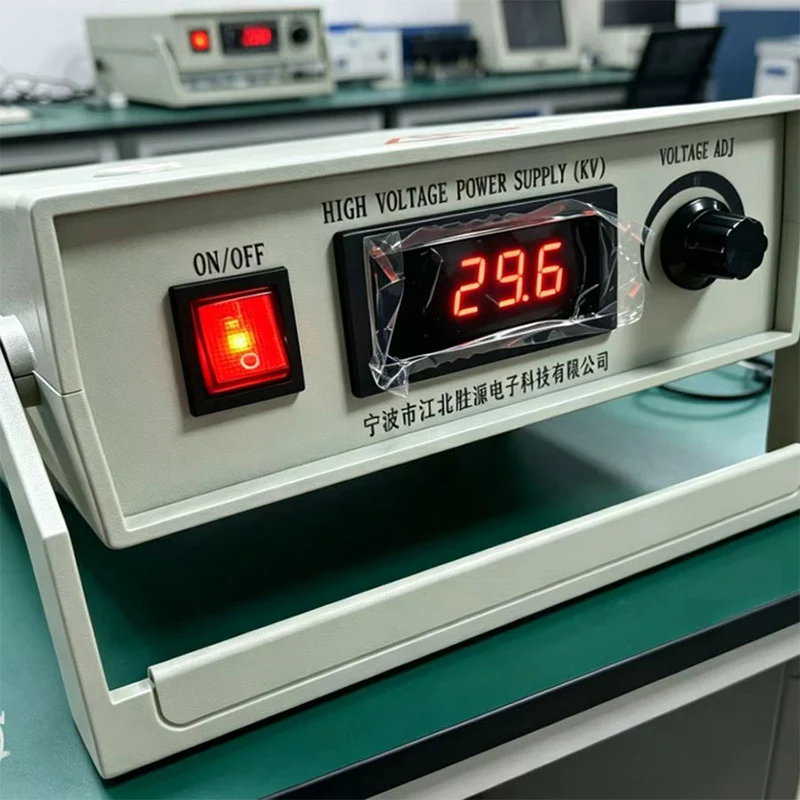
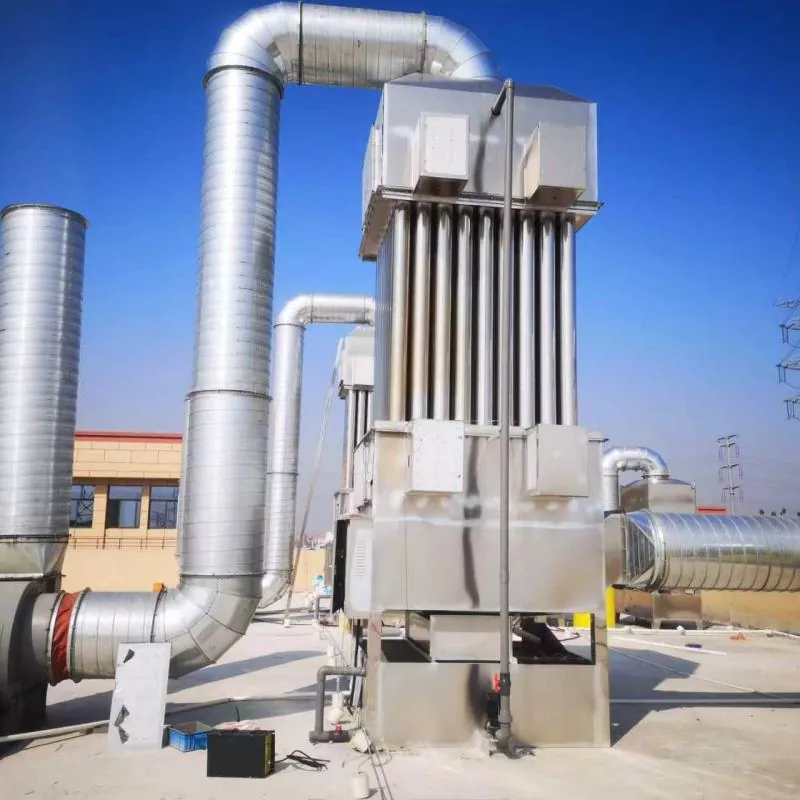
A mixed acid-and-solvent stream may justify an acid scrubber followed by solvent control. DeFa's three-acid treatment overview describes spray-tower and wet-electrostatic stages for acid gas and acid mist. That application does not establish removal of unrelated solvent vapor.
The handoff to a carbon bed, concentrator or oxidizer should state residual compounds, gas flow, temperature, water vapor, droplet carryover and remaining corrosive contaminants. A demister removes droplets; it does not, by itself, remove water vapor. Downstream equipment therefore needs its own inlet specification.
For carbon, evaluate the conditioned gas and residual mass load against working capacity and breakthrough requirements. The activated carbon operating guide covers that duty. For a thermal system, assess the residual chemistry and heat balance. Neither device should be chosen simply because it appears next in a standard process diagram.
A useful acceptance test includes aged liquid and the hardest production case
A short test with fresh water can miss the condition that limits the system later. Ask the proposal to define the circulating-liquid condition at which the outlet must be achieved, along with gas loading, recipe and temperature. If stable liquid loading takes time, the testing plan must account for that.
| Field | Required answer |
|---|---|
| Pollutants and phases | Individual VOCs, inorganic gases, aerosol and particle duties identified separately. |
| Operating envelope | Normal and peak flow, mass load, temperature and production/cleaning recipes. |
| Absorbent basis | Liquid composition, equilibrium or reaction method, and maximum expected pollutant loading. |
| Liquid destination | Blowdown or regeneration rate, dissolved pollutant load, and treatment or recovery capacity. |
| Gas outlet requirement | Compound-specific or applicable total measurement, method, averaging basis and sampling locations. |
| Downstream handoff | Temperature, humidity, droplet carryover, corrosion-related constituents and residual VOC mass. |
| Verification | Paired gas measurements and liquid records during representative sustained operation. |
Cost those duties together. Water, reagent, wastewater, packing cleaning, fan power and downstream conditioning can change the economics. The VOC system cost guide provides the broader comparison framework.
Send a compound list, not just a total VOC number
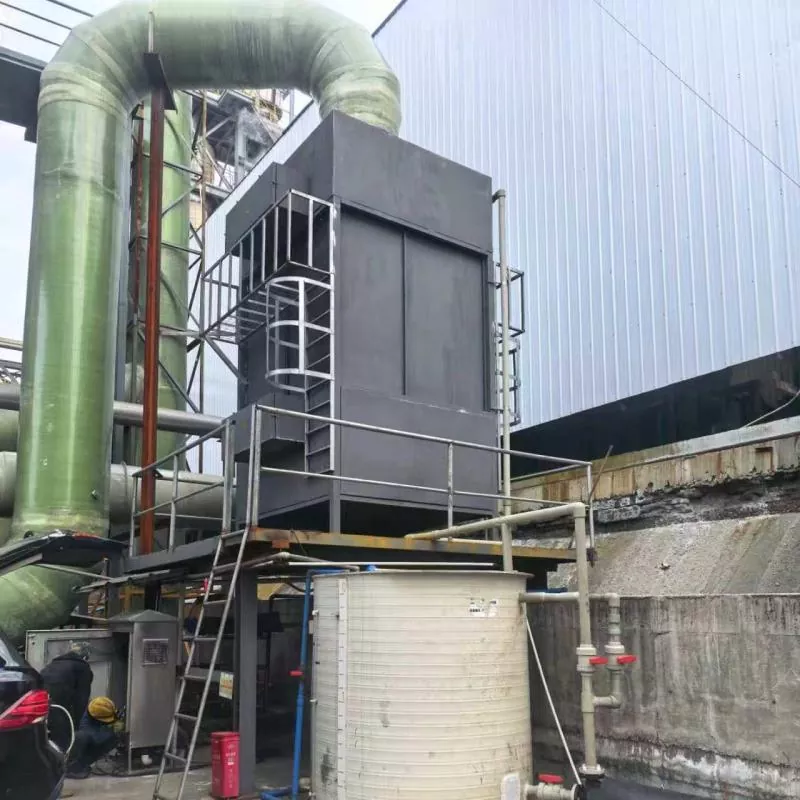
DeFa's equipment catalogue includes spray-tower and combined treatment options. For a project review, send the compound profile, normal and peak loads, existing liquid-loop data and required outlet. This gives the project team a basis for deciding whether the scrubber is a main removal stage, pretreatment, or an unsuitable route for the solvent duty.