Which Industrial Dust Removal Equipment Can Handle High-Temperature Exhaust Gas?
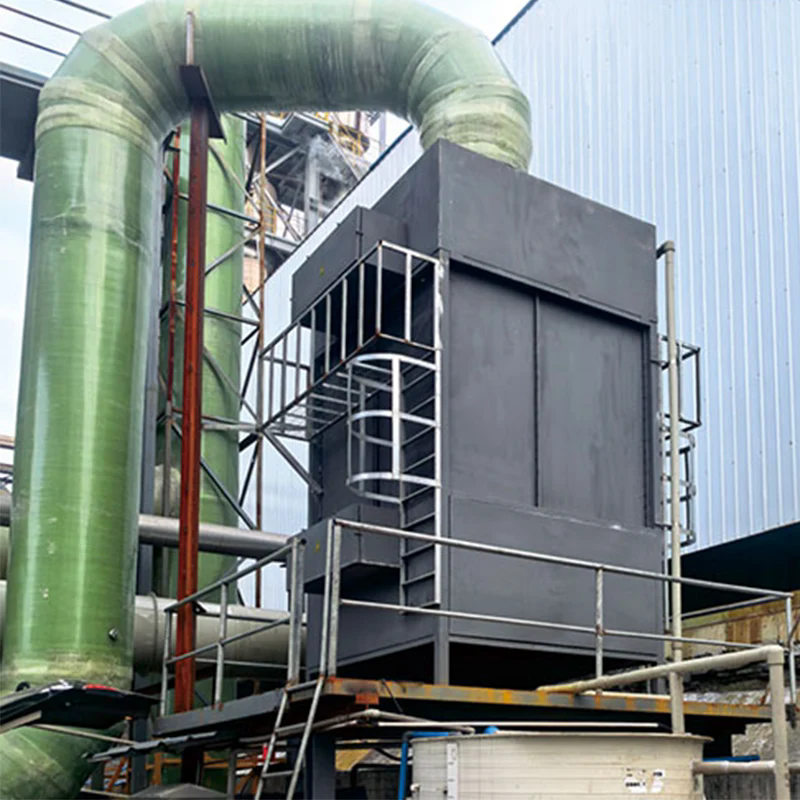
High-temperature exhaust gas is one of the most demanding conditions in industrial dust removal. Flue gas from a cement kiln, a steel furnace, a biomass boiler, or an incinerator can exceed 300°C, and in some processes it approaches 500°C. At these temperatures, the dust removal equipment must do more than capture particles. It must survive. Standard filter media degrade, seals harden, and structural components distort. The choice of Industrial Dust Removal Equipment for a high-temperature application is therefore not a matter of selecting the most efficient collector. It is a matter of selecting the collector whose materials and design can tolerate the temperature while still meeting the emission limit.
This guide is written for buyers who are sourcing Industrial Dust Removal Equipment for high-temperature exhaust gas. We will examine the main equipment types—bag filters, electrostatic precipitators, ceramic filter systems, and cyclones—and explain their temperature limits, their advantages, and their limitations. We will provide a comparison table, a selection framework, and the criteria for evaluating a supplier. We will also provide detailed product parameters from our factory at DeFa Environmental Equipment (Ningbo) Co., Ltd. Whether you are specifying equipment for a cement plant, a metallurgical furnace, a waste-to-energy boiler, or a chemical process, this guide will help you identify the equipment that can handle the temperature and the duty.
Table of Contents
- 1. What Temperature Ranges Do Different Dust Removal Technologies Cover?
- 2. How Far Can Bag Filters Be Pushed with High-Temperature Filter Media?
- 3. When Does an Electrostatic Precipitator Make More Sense Than a Bag Filter?
- 4. What Role Do Ceramic Filters and Cyclones Play in Extreme Temperature?
- 5. How Do You Select the Right Equipment for a Specific High-Temperature Process?
- 6. How Do You Evaluate a High-Temperature Dust Removal Equipment Supplier?
- 7. What Are the Key Product Parameters from Our Factory?
- 8. Frequently Asked Questions (FAQ)
- 9. Conclusion
1. What Temperature Ranges Do Different Dust Removal Technologies Cover?
The first question in selecting high-temperature Industrial Dust Removal Equipment is not which technology is best, but which technology can operate at the temperature without failing. Each technology has a practical temperature ceiling determined by its materials. A standard polyester bag filter is limited to about 130°C. A PPS bag filter reaches about 170°C. A PTFE bag filter reaches about 260°C. A ceramic filter can operate at 500°C or higher. An electrostatic precipitator can handle gas temperatures up to about 400°C, depending on the electrode and insulator materials. A cyclone has no filter media, so its temperature limit is determined by the steel and the refractory lining, and it can operate at 800°C or more. The table below summarizes the practical temperature ranges.
| Technology | Practical Temperature Limit | Limiting Factor | Typical Application |
| Standard Bag Filter (Polyester) | 130°C | Filter media | General ventilation, low-temp processes |
| PPS Bag Filter | 170°C | Filter media | Coal-fired boilers, waste incineration |
| PTFE Bag Filter | 260°C | Filter media | Cement kilns, metallurgical furnaces |
| Electrostatic Precipitator | 400°C | Electrodes, insulators | Power plants, cement kilns, steel |
| Ceramic Filter | 500°C+ | Ceramic element | Biomass gasification, incineration |
| Cyclone | 800°C+ | Steel, refractory lining | Pre-cleaning, high-temp coarse dust |
At DeFa Environmental Equipment (Ningbo) Co., Ltd., our factory manufactures Industrial Dust Removal Equipment across these technology categories. We do not recommend a single technology for every high-temperature application. The correct choice depends on the temperature, the dust characteristics, the emission limit, and the available space. Our engineering team can help you map the process conditions to the technology that can handle them.
2. How Far Can Bag Filters Be Pushed with High-Temperature Filter Media?
Bag filters can be pushed to higher temperatures by changing the filter media. The bag filter itself is a proven, high-efficiency collector. Its limitation is the fabric. Standard polyester is limited to about 130°C. PPS extends the limit to about 170°C. PTFE extends it to about 260°C. Glass fiber can reach about 280°C. Polyimide reaches about 240°C. The choice of media determines not only the temperature limit but also the chemical resistance, the cleaning behavior, and the cost. The table below compares the main high-temperature filter media.
| Filter Media | Max Continuous Temperature | Chemical Resistance | Relative Cost |
| Polyester | 130°C | Good (limited to neutral gases) | Low |
| PPS (Polyphenylene Sulfide) | 170°C | Good (resists acids, limited to low oxygen) | Medium |
| Polyimide | 240°C | Good (resists acids and alkalis) | Medium-High |
| PTFE | 260°C | Excellent (resists most chemicals) | High |
| Glass Fiber | 280°C | Moderate (limited to dry, neutral gases) | Medium |
| Ceramic (for bag-like elements) | 500°C+ | Excellent | Very High |
At our factory, we supply Industrial Dust Removal Equipment with bag filters using PPS, PTFE, and glass fiber media for high-temperature applications. We work with our customers to select the media that matches the gas temperature and the chemical composition. The key is not to push a media beyond its limit. A PTFE bag filter that is rated for 260°C will degrade quickly if the process occasionally reaches 300°C. The specification must account for the peak temperature, not only the average. Our engineering team can review the process data and recommend the media with the appropriate margin.
Bag filters have a further advantage: they can be combined with pre-cooling. If the gas temperature is above the media limit, a pre-cooler—such as a heat exchanger, a dilution air damper, or a spray cooler—can reduce the temperature before the gas enters the bag filter. This approach is common in cement and metallurgical plants where the raw gas temperature exceeds the bag limit. The bag filter then operates within its safe range, and the high-efficiency filtration is preserved. The trade-off is the added cost and complexity of the pre-cooling system. For many applications, this trade-off is still more economical than a ceramic filter or an ESP.
3. When Does an Electrostatic Precipitator Make More Sense Than a Bag Filter?
An electrostatic precipitator (ESP) makes more sense than a bag filter when the gas temperature is high and the dust load is heavy, and when the process cannot tolerate the pressure drop of a bag filter. An ESP operates by charging the dust particles and collecting them on oppositely charged plates. It has a very low pressure drop, which reduces the fan energy consumption. It can handle gas temperatures up to about 400°C, and it can handle high dust concentrations and corrosive gases if the materials are selected correctly. The table below compares the ESP with the bag filter in high-temperature applications.
| Parameter | Electrostatic Precipitator | Bag Filter |
| Temperature Limit | ~400°C | 130°C - 280°C (media dependent) |
| Pressure Drop | Very low (200-500 Pa) | Moderate to high (1000-2000 Pa) |
| Efficiency | High (99%+ for coarse dust) | Very high (99.9%+ for fine dust) |
| Space Requirement | Large | Compact |
| Sensitivity to Dust Resistivity | High | Low |
| Typical Application | Power plants, cement kilns, steel furnaces | Cement kilns, incinerators, metallurgical |
The ESP has two limitations that buyers should understand. First, its efficiency depends on the dust resistivity. If the dust is too conductive or too resistive, the ESP performance drops. Second, the ESP is larger than a bag filter for the same gas volume, which can be a constraint on a brownfield site. At our factory, we supply Industrial Dust Removal Equipment including ESPs for high-temperature applications where the dust characteristics and the site conditions are suitable. We evaluate the dust resistivity and the gas composition before recommending an ESP.
In many modern plants, the ESP and the bag filter are combined in a hybrid arrangement. The ESP removes the coarse dust, and the bag filter polishes the gas to meet the emission limit. This arrangement can be useful when the gas temperature is high and the dust load is heavy, but the emission limit is very low. The ESP reduces the dust load and the temperature, and the bag filter provides the final filtration. Our engineering team can design this hybrid arrangement when the process conditions justify it.
4. What Role Do Ceramic Filters and Cyclones Play in Extreme Temperature?
Ceramic filters and cyclones play a specific role when the temperature is beyond the practical range of bag filters and ESPs. A ceramic filter uses rigid ceramic elements—candles or tubes—that can operate at 500°C or higher. They are used in biomass gasification, hazardous waste incineration, and some metallurgical processes where the gas is hot and the emission limit is strict. The ceramic element is resistant to high temperature and to chemical attack, but it is fragile and expensive, and the cleaning method must be designed to avoid mechanical shock. The table below summarizes the role of ceramic filters and cyclones.
| Equipment | Temperature Range | Advantage | Limitation |
| Ceramic Filter | 500°C+ | High efficiency at extreme temperature | High cost, fragile elements |
| Cyclone | 800°C+ | Simple, robust, low cost | Lower efficiency for fine dust |
A cyclone is the simplest high-temperature dust removal device. It has no filter media and no electrodes. The gas enters tangentially, and the centrifugal force throws the dust particles to the wall, where they fall into a hopper. A cyclone can operate at 800°C or higher if the steel and the refractory lining are selected correctly. Its efficiency is lower than a bag filter or an ESP, especially for fine particles, but it is often used as a pre-cleaner before a bag filter or an ESP. The cyclone reduces the dust load and protects the downstream equipment.
At DeFa Environmental Equipment (Ningbo) Co., Ltd., our factory manufactures Industrial Dust Removal Equipment including ceramic filters and cyclones for extreme-temperature applications. We evaluate the gas temperature, the dust particle size, and the emission limit before recommending the combination. In many cases, the best solution is a cyclone pre-cleaner followed by a ceramic filter or a bag filter with pre-cooling. The combination provides the required efficiency at a lower cost than a single extreme-temperature device. Our engineering team can model the system and recommend the configuration that meets the process requirements.
5. How Do You Select the Right Equipment for a Specific High-Temperature Process?
Selecting the right equipment for a specific high-temperature process is a step-by-step evaluation. The first step is to define the gas temperature, including the normal operating temperature and the peak temperature. The second step is to define the dust characteristics: the concentration, the particle size distribution, the chemical composition, and the resistivity. The third step is to define the emission limit and the required collection efficiency. The fourth step is to evaluate the available space and the pressure drop budget. The fifth step is to compare the technologies against these requirements and to select the one that meets them with an adequate margin. The table below summarizes this selection framework.
| Step | Data Required | Decision Impact |
| 1 | Gas temperature (normal and peak) | Determines the technology class |
| 2 | Dust concentration, size, chemistry, resistivity | Determines the media or electrode choice |
| 3 | Emission limit and efficiency target | Determines the required stage count |
| 4 | Space and pressure drop budget | Determines the physical configuration |
| 5 | Technology comparison | Final selection with margin |
At our factory, we work with our customers through this framework. We ask for the process data and we model the performance of the candidate technologies. We do not recommend a technology based on a single data point. A gas temperature of 300°C does not automatically mean a ceramic filter. It may be handled by a PTFE bag filter with pre-cooling, or by an ESP, depending on the dust and the emission limit. The selection must consider all the data together.
One practical consideration is the operating cost. A bag filter has a higher pressure drop than an ESP, which means higher fan energy consumption. An ESP has lower pressure drop but a larger footprint and a higher capital cost. A ceramic filter has a high capital cost and a high replacement cost for the elements. The selection should compare the total cost of ownership over the expected service life, not only the initial price. Our engineering team can provide the operating cost estimate for each option.
6. How Do You Evaluate a High-Temperature Dust Removal Equipment Supplier?
Evaluating a supplier of high-temperature Industrial Dust Removal Equipment requires a focus on material selection, thermal design, reference projects, and after-sales support. The supplier must have experience with the specific temperature range and the specific process. They must be able to select the materials—filter media, electrodes, ceramics, steel, refractory—that can tolerate the temperature and the gas chemistry. They must provide reference projects in similar applications. And they must provide after-sales support, including spare parts and service. The table below summarizes the evaluation criteria.
| Evaluation Criterion | What to Look For | Why It Matters |
| Material Selection | Experience with PTFE, ceramic, high-temp steel | Ensures the equipment survives the temperature |
| Thermal Design | Insulation, expansion joints, cooling design | Prevents distortion and heat loss |
| Reference Projects | Similar temperature and process experience | Demonstrates capability |
| After-Sales Support | Spare parts, service, performance guarantee | Ensures long-term operation |
| Testing Capability | Pilot testing, performance modeling | Verifies the design before purchase |
At our factory, we have been manufacturing Industrial Dust Removal Equipment for high-temperature applications for over a decade. We have experience with bag filters using PPS, PTFE, and glass fiber media, with ESPs, with ceramic filters, and with cyclones. We have reference projects in cement, metallurgy, waste incineration, and biomass. Our technical team is available to assist with the selection and to provide performance modeling. We invite you to evaluate us against these criteria and to consider us as your partner for high-temperature dust removal.
7. What Are the Key Product Parameters from Our Factory?
The following table provides the key product parameters for our high-temperature Industrial Dust Removal Equipment. These systems are available in bag filter, ESP, ceramic filter, and cyclone configurations to suit different temperature ranges and process requirements. Our factory can also produce custom systems to meet specific project conditions.
| Parameter | Specification Range | Notes |
| Equipment Type | Bag Filter, ESP, Ceramic Filter, Cyclone | Selected for temperature and duty |
| Maximum Operating Temperature | 130°C - 800°C | Depends on technology and materials |
| Filter Media (Bag) | PPS, PTFE, Glass Fiber, Polyimide | Selected for temperature and chemistry |
| Collection Efficiency | 95% - 99.9%+ | Depends on technology and dust size |
| Pressure Drop | 200 - 2000 Pa | Depends on technology |
| Gas Flow Rate | 1,000 - 500,000 m³/h | Custom designs available |
| Housing Material | Carbon Steel, Stainless Steel, Refractory-lined | Selected for temperature and corrosion |
| Insulation | Mineral wool, ceramic fiber | Prevents heat loss and condensation |
| MOQ | 1 unit | Negotiable for large orders |
| Lead Time | 8 - 16 weeks | Depends on size and customization |
At our factory, we manufacture our high-temperature Industrial Dust Removal Equipment to meet these specifications and more. We can customize the technology, the materials, the insulation, and the control system to suit your specific process conditions. Our quality control system includes inspection of raw materials, in-process inspection, and final inspection before shipment. Our goal is to provide our customers with high-temperature dust removal equipment that operates reliably and meets the emission limit.
8. Frequently Asked Questions (FAQ)
Question 1: What is the maximum temperature a bag filter can handle?
Answer: The maximum temperature depends on the filter media. Standard polyester is limited to about 130°C. PPS reaches about 170°C. Polyimide reaches about 240°C. PTFE reaches about 260°C. Glass fiber reaches about 280°C. For temperatures above 280°C, a ceramic filter, an ESP, or a pre-cooling system is required. Our engineering team can recommend the appropriate media for your gas temperature and chemistry.
Question 2: When should I choose an ESP instead of a bag filter for high-temperature gas?
Answer: Choose an ESP when the gas temperature is above the practical limit of bag filter media, when the dust load is heavy, when the pressure drop budget is low, and when the dust resistivity is in the suitable range. An ESP can handle temperatures up to about 400°C and has a very low pressure drop. However, it is larger and more sensitive to dust resistivity than a bag filter. The selection should be based on the full process data, not on temperature alone.
Question 3: Can a cyclone handle the highest temperatures?
Answer: Yes, a cyclone can handle the highest temperatures of any dust removal technology, up to 800°C or more, because it has no filter media or electrodes. Its temperature limit is determined by the steel and the refractory lining. However, a cyclone has lower efficiency for fine dust, so it is often used as a pre-cleaner before a bag filter or an ESP rather than as the final collector.
Question 4: What is the role of pre-cooling in high-temperature dust removal?
Answer: Pre-cooling reduces the gas temperature before it enters the dust removal equipment. This allows a bag filter with a lower-temperature media to be used, or it reduces the thermal load on an ESP or a ceramic filter. Common pre-cooling methods include heat exchangers, dilution air dampers, and spray coolers. The choice depends on the gas temperature, the available space, and the process constraints. Our engineering team can design the pre-cooling system as part of the overall solution.
Question 5: How do I compare the total cost of ownership of different high-temperature dust removal options?
Answer: Compare the capital cost, the operating cost, and the maintenance cost over the expected service life. The capital cost includes the equipment, the installation, and the auxiliaries. The operating cost includes the fan energy, the compressed air for cleaning, and the reagent consumption. The maintenance cost includes the replacement of filter media, ceramic elements, electrodes, and worn parts. A bag filter may have a lower capital cost but a higher pressure drop and media replacement cost. An ESP may have a higher capital cost but a lower pressure drop and longer component life. Our engineering team can provide a total cost of ownership estimate for each option.
9. Conclusion
High-temperature exhaust gas requires Industrial Dust Removal Equipment that is selected for the temperature, the dust characteristics, and the emission limit. Bag filters with PPS, PTFE, or glass fiber media can handle temperatures up to about 280°C. Electrostatic precipitators can handle up to about 400°C with a low pressure drop. Ceramic filters can handle 500°C or more. Cyclones can handle 800°C or more but with lower efficiency. The correct choice is not a single technology for all high-temperature applications. It is a combination of technology, material, and pre-cooling that matches the specific process. At DeFa Environmental Equipment (Ningbo) Co., Ltd., our factory manufactures Industrial Dust Removal Equipment across these technology categories and provides the engineering support to select the right configuration. We work with our customers to evaluate the process data and to recommend the equipment that meets the temperature and the emission limit.
Whether you are specifying equipment for a cement kiln, a metallurgical furnace, a waste-to-energy boiler, or a chemical process, we invite you to contact us to discuss your requirements. We can provide process modeling, reference projects, and customized solutions. Our commitment to quality and customer satisfaction has made us a trusted partner for high-temperature dust removal projects around the world.
Contact DeFa Environmental Equipment (Ningbo) Co., Ltd. today to discuss your high-temperature Industrial Dust Removal Equipment requirements and discover how our solutions can meet your process conditions.
Related News
- How Does Industrial Dust Removal Equipment Address High-Humidity Dust Collection Conditions?
- How Can a Rectangular Air Volume Control Damper Improve HVAC Efficiency and Airflow Precision
- Industrial VOC Removal: How Pretreatment Protects Activated Carbon, Zeolite Rotors and RTO Systems
- How Can an Acidic Waste Gas Treatment System Improve Industrial Safety and Emission Control
- How Can a Quenching Furnace Oil Fume Purification System Improve Industrial Air Quality and Production Efficiency
- How Can High-Viscosity Oil Fume Purification Equipment Improve Industrial Air Quality and Production Efficiency
Leave me a message
New Products
News Recommendations