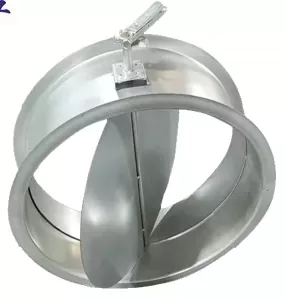
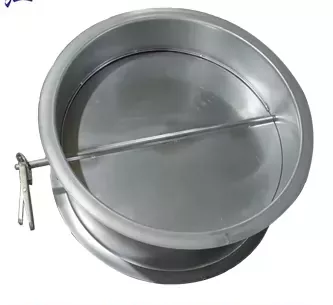
Round Air Volume Control Damper
Defa Round Air Volume Control Damper regulates and balances airflow in circular HVAC, ventilation, and process air ducts. Available in manual and motorized versions from Φ100 to Φ2000 mm, it supports custom materials, actuators, control signals, and connection types for reliable airflow control and zone regulation.
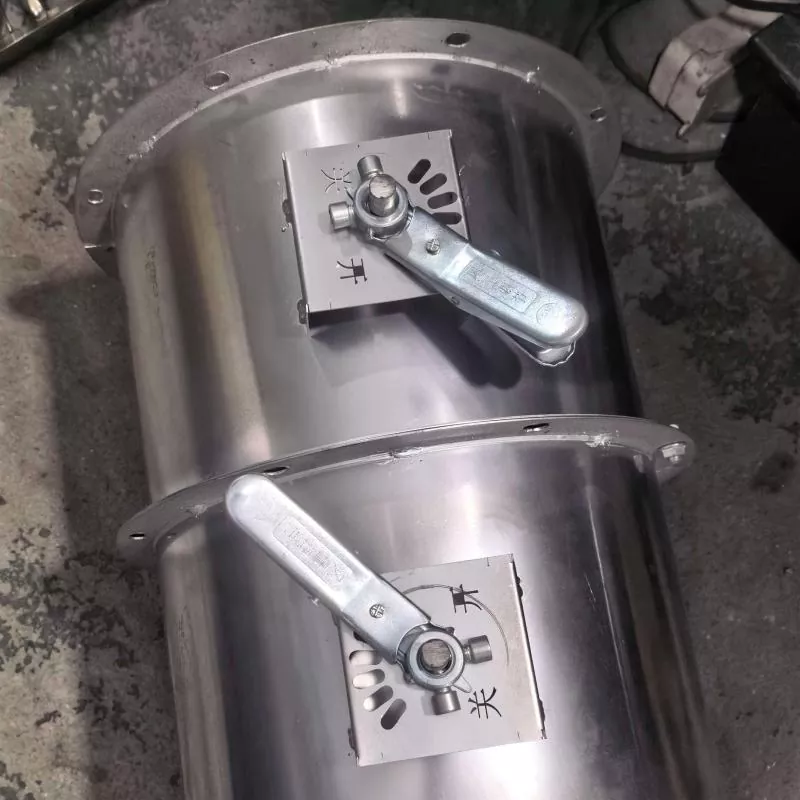
DeFa round air volume control dampers are used to adjust airflow in circular duct systems. The product range includes manually operated versions and motorized versions with electric actuators. Nominal diameters from Φ100 to Φ2000 can be produced. Standard body materials include carbon steel and stainless steel. These dampers are supplied by Shengyuan Technology under the DeFa brand, a manufacturer with more than 20 years of experience in environmental control equipment and high voltage power systems.
The dampers are suitable for ventilation, air conditioning, and process air systems where airflow balancing or zone control is required. Both standard dimensions and custom sizes are available. The design focuses on reliable blade movement, low leakage in the closed position, and compatibility with common actuator control signals.
Technical Parameters
| Parameter | Specification |
| Diameter Range | Φ100 mm to Φ2000 mm |
| Body Material | Carbon steel (galvanized or painted) or stainless steel 304/316 |
| Blade Material | Same as body material or optional aluminum |
| Blade Type | Single blade or multi-blade, depending on diameter |
| Control Mode | Manual handle / hand wheel, or electric actuator |
| Actuator Voltage | 24V AC/DC, 220V AC, or others on request |
| Control Signal | 0-10V DC, 4-20mA, or three-point floating |
| Working Pressure | Up to 1000 Pa standard; higher on request |
| Operating Temperature | -20°C to +70°C standard |
| Leakage Rate | Class 1 to Class 3 according to GB/T 14294 or EN 1751 |
| Connection Type | Flanged, slip-fit, or clamp type as required |
| Actuator Protection | IP42 indoor; IP54 or higher for outdoor use |
Control Modes
Manual Operation
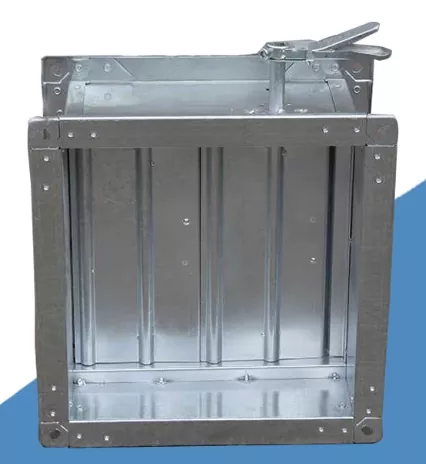
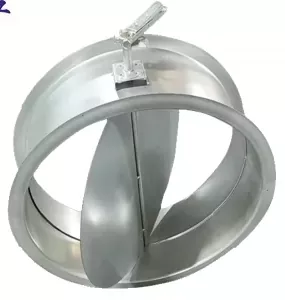
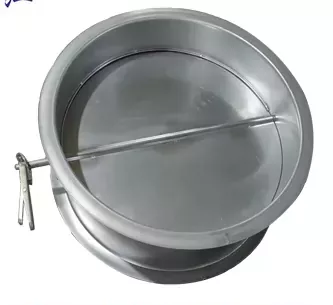
The manual version is fitted with a locking quadrant handle or a hand wheel. The handle position indicates the blade angle and can be fixed after adjustment. This type is commonly used during system commissioning to balance branch ducts. No external power is needed.
Motorized Operation
The motorized version uses an electric actuator mounted on the damper shaft. The actuator can be controlled by a building management system or a room controller. Modulating actuators accept 0-10V or 4-20mA signals for continuous adjustment. Two-position actuators are available for simple open and close duty.
Manual and Motorized Combined
Some configurations allow both manual override and electric actuation. A manual override function on the actuator permits local operation during maintenance or when power is lost. This combined option is useful for commissioning and emergency adjustment.
Construction Details
The damper body is formed from rolled steel or stainless steel sheet, with a circular cross-section matching the duct. For diameters up to approximately Φ300 mm, a single butterfly blade is typical. For larger diameters, multi-blade arrangements with opposing or parallel blade movement are used to maintain smooth airflow modulation.
Blade shafts are supported by self-lubricating bearings. Blade edge seals and internal stops reduce air leakage when the damper is closed. The outer surface can be galvanized, painted, or left as natural stainless steel according to environmental requirements.
Material Selection
- Carbon steel: Suitable for general ventilation and air conditioning. Galvanized or powder-coated finishes provide basic corrosion resistance for indoor use.
- Stainless steel 304: Recommended for humid environments, such as swimming pools, kitchens, and coastal buildings.
- Stainless steel 316: Used in chemical fume exhaust, laboratory ventilation, and other applications with corrosive gases.
Installation Notes
- Install the damper in a straight duct section. A straight run of 2 to 3 duct diameters upstream and downstream improves flow measurement and control accuracy.
- For manual dampers, ensure the handle is accessible for adjustment and that the position scale is visible.
- For motorized dampers, verify that the actuator rotation direction corresponds to the control signal before closing the duct.
- Use flexible connections where vibration isolation is required.
- For flanged models, tighten bolts evenly to avoid body distortion.
Maintenance
- Every 3 months: Check that blades move freely without binding. Clean dust from blade edges and seals.
- Every 6 months: Inspect bearings for wear and verify that the actuator position feedback matches the actual blade angle.
- Annually: For motorized versions, test the full stroke and fail-safe function if applicable. Replace worn seals or corroded parts.
Frequently Asked Questions
Can the damper be upgraded from manual to motorized later?
In many cases, yes. The damper shaft can accept an electric actuator if a mounting bracket is added. However, it is better to specify the motorized version at the time of order because the shaft length and torque requirements may differ. Our team can advise on retrofit options.
What diameter should be chosen for a given airflow?
The diameter should match the duct size and the design air velocity. A typical design velocity for ventilation ducts is 4 to 8 m/s. Based on this, the diameter can be calculated. If you provide the airflow volume and pressure, we can help confirm the appropriate damper size.
Which actuator torque is required?
Actuator torque depends on the damper area, blade type, and differential pressure. For small diameters up to Φ300 mm, 5 Nm is usually sufficient. For larger diameters or high pressure differentials, 10 Nm to 20 Nm or more may be needed. We can recommend a suitable actuator based on your conditions.
Is the damper suitable for outdoor installation?
Yes, if the appropriate material and actuator protection are selected. Stainless steel body and IP54 or higher actuator are recommended for outdoor use. A weather shield over the actuator is also advised.
Does the damper provide airtight shut-off?
The standard leakage class is not bubble-tight. For most ventilation balancing applications, Class 1 or 2 is sufficient. If tighter shut-off is required, special seals and blade design can be provided, but full airtight performance is limited by the circular blade design.
What information is needed for a quotation?
Please provide the diameter, material, control mode (manual or motorized), actuator voltage and signal type, and any special requirements such as flange standard or surface finish. This allows us to prepare an accurate offer.
About Shengyuan Technology
Shengyuan Technology (DeFa brand) has over 20 years of experience in manufacturing environmental control components and high voltage systems for air purification. The company serves customers in North America, Europe, and Asia. Round air volume control dampers are produced with the same quality management approach used for our electronic products, including dimensional checks, material traceability, and actuator functional testing before shipment.
Hot Tags: Round Air Volume Control Damper, Air Volume Control Damper, HVAC Round Damper
Send Inquiry
Contact Info
-
Address
No. 661 Cangchu Road, Jiangbei District, Ningbo City,ZHEJIANG PROVINCE,CHINA
-
Tel
-
E-mail
For inquiries about our products or pricelist, please leave your email to us and we will be in touch within 24 hours.